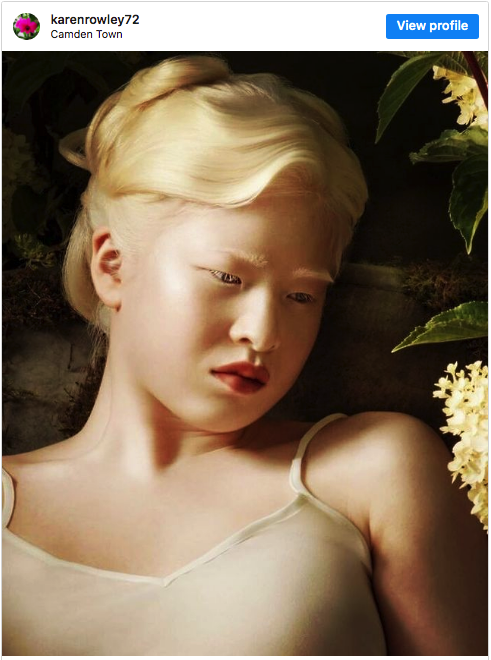
The lives of young children are shaped first and foremost by their parents, whose presence provides the foundation for emotional security, physical well-being, and a sense of belonging. From the earliest moments of life, children depend on their caregivers for protection, affection, and acceptance, all of which are essential for healthy growth and development. When this bond is broken—whether through abandonment, loss, or circumstance—the effects can be profound and long-lasting. For many children around the world, growing up without parental care means facing not only emotional wounds but also social stigma and uncertainty about their place in the world. This reality was tragically true for Xueli Abbing, a baby girl born in China with albinism, whose life began not with celebration but with rejection. Viewed as “different” and misunderstood because of her appearance, she was abandoned by her biological parents and left at the door of an orphanage, her future uncertain from the very first days of her life.
At the orphanage, caregivers gave the infant a name filled with meaning and tenderness: Xueli. In Chinese, “Xue” evokes the purity and brightness of snow, while “Li” signifies beauty—together forming a name that captured both her striking appearance and her inherent worth. Xueli was born with albinism, a genetic condition characterized by a lack or reduction of melanin, resulting in very light skin, hair, and eye color, often accompanied by visual impairment. Although albinism is a medical condition with a clear scientific explanation, it is frequently surrounded by harmful myths and misconceptions. In many cultures, people with albinism are stigmatized, ostracized, or even feared, simply because they look different. For Xueli, this misunderstanding cost her the care of her biological family, but it did not define the rest of her story. Fate intervened when she was adopted by a loving family in the Netherlands, who welcomed her wholeheartedly and raised her with affection, stability, and encouragement.
Growing up in Europe, Xueli experienced a childhood far removed from the abandonment that marked her earliest days. Her adoptive parents supported her education, nurtured her confidence, and ensured she understood that her albinism did not diminish her value. Despite visual challenges associated with the condition, she learned to navigate the world with resilience and curiosity. Her life took an unexpected turn when, at just eleven years old, she was invited to participate in a photoshoot in Hong Kong by a designer who wanted to celebrate diverse forms of beauty. The project, titled “Perfect Imperfections,” sought to challenge conventional standards in the fashion industry by highlighting uniqueness rather than conformity. In an interview with the BBC, Xueli recalled how the opportunity felt both exciting and surreal, describing it as a fantastic experience that opened her eyes to a world she had never imagined being part of. What began as a single photoshoot soon became the first step in a modeling career that would bring her international recognition.
As her profile grew, Xueli became increasingly aware of the broader realities faced by people with albinism around the world. Albinos often endure discrimination not only because of their skin tone but also because of deeply rooted superstitions. In some regions, particularly parts of Africa, individuals with albinism are subjected to extreme violence due to the false belief that their body parts possess magical or medicinal properties. Reflecting on these realities, Xueli once remarked that she considered herself “lucky” to have been abandoned rather than subjected to worse fates faced by others. She has also spoken openly about how it saddens her when models with albinism are stereotypically cast as angels, ghosts, or otherworldly beings, reinforcing the idea that they are somehow not fully human. For Xueli, representation matters—not as fantasy, but as reality—where people with differences are portrayed as ordinary individuals with complex identities and lives.
Her modeling career reached a major milestone when a London-based photographer recognized her potential and treated her with the professionalism and respect every model deserves. Their collaboration led to a striking photoshoot that earned Xueli a feature in the June 2019 issue of Vogue Italia, one of the world’s most influential fashion magazines. At the time, she did not fully grasp the significance of the achievement, later recalling that it took her a while to understand why people reacted with such excitement. The moment marked more than personal success; it symbolized a shift within the fashion industry toward greater inclusivity. Xueli has since reflected on how modeling is slowly evolving, noting that while extreme body standards once dominated, there is now more space for people with disabilities and visible differences. Still, she emphasizes that true progress will come only when diversity is no longer treated as exceptional but as normal.
Beyond fashion, Xueli’s experiences have shaped her perspective on beauty in deeper ways. Because of her visual impairment, she has explained that she often focuses more on people’s voices, emotions, and words, valuing inner qualities over outward appearance. This outlook has fueled her desire to use her platform to educate others about albinism, stressing that it is a hereditary condition rather than a curse. She is careful with language, preferring the phrase “a person with albinism” over labels that reduce individuals solely to their condition. Above all, Xueli is driven by a strong sense of purpose. She has spoken passionately about her refusal to accept a world in which children are harmed or killed because of albinism, declaring her determination to help change perceptions and attitudes. From a baby left behind to a global symbol of resilience and advocacy, Xueli Abbing’s journey stands as a powerful reminder that difference is not a flaw, and that with compassion, understanding, and opportunity, lives can be transformed.