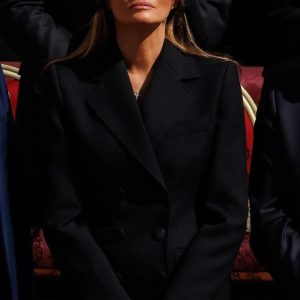
Public debates in modern politics increasingly blur the line between policy, personality, and personal image, and few examples illustrate this more clearly than recurring comparisons between former first ladies Melania Trump and Michelle Obama. What often begins as commentary about public influence or cultural impact quickly devolves into arguments about appearance, worthiness, and moral authority. These discussions rarely stay confined to thoughtful critique; instead, they are amplified through headlines, social media posts, and partisan commentary that frame one woman as inherently superior to the other. Such framing says less about the individuals involved and more about the broader political environment that encourages symbolic conflict over substantive engagement. In an age where every public figure becomes a canvas for ideological projection, first ladies—despite holding no elected power—are repeatedly drawn into battles they did not initiate and cannot easily escape.
Michelle Obama’s tenure as first lady was marked by highly visible initiatives focused on health, education, and military families, and she became widely regarded as a role model for her advocacy, oratory skills, and public warmth. For many Americans, she came to symbolize a version of leadership rooted in empathy and civic responsibility. Melania Trump, by contrast, maintained a far more reserved public presence, choosing fewer initiatives and appearing less frequently in political discourse. This difference in approach has often been interpreted not as a stylistic choice, but as a moral or personal failing, especially by critics who view visibility as synonymous with value. Yet public engagement is not a universal metric, and the expectation that every first lady must perform influence in the same way ignores the diversity of personalities and backgrounds that shape how individuals navigate public life.
The language used in these comparisons often shifts from analysis into judgment, particularly when discussions turn toward physical appearance. When beauty is invoked as a measure of legitimacy or superiority, it reflects long-standing cultural habits of evaluating women—especially women in the public eye—through aesthetic lenses rather than intellectual or ethical ones. These conversations risk reinforcing harmful standards by implying that worth can be ranked, that role models must conform to a singular ideal, and that visibility or admiration is a zero-sum game. Such rhetoric ultimately diminishes both women, reducing complex individuals to symbols in a broader ideological contest. It also distracts from more meaningful conversations about leadership, influence, and the structural roles assigned to women adjacent to power.
Media ecosystems play a powerful role in sustaining and intensifying these narratives. Outrage-driven headlines and viral posts reward sharp contrasts and emotionally charged claims, encouraging audiences to take sides rather than reflect. Comparisons between Melania Trump and Michelle Obama are often framed not to inform, but to provoke, reinforcing existing political identities. Supporters and critics alike are drawn into cycles of defense and attack that mirror broader partisan divides. In this environment, nuance struggles to survive. The question is rarely whether a comparison is fair or constructive, but whether it serves a particular narrative. As a result, discussions about first ladies become stand-ins for debates about race, class, immigration, gender roles, and national identity, all compressed into easily shareable judgments.
Lost in this discourse is a broader reflection on why first ladies are expected to embody moral leadership at all. The role itself is undefined, shaped more by tradition and public expectation than by constitutional responsibility. Some first ladies choose activism, others prefer privacy, and neither approach is inherently superior. Elevating one model while dismissing another assumes a uniform standard that has never truly existed. It also overlooks the pressures placed on women connected to political power, who are scrutinized for everything from clothing choices to facial expressions. When comparisons become weapons, they discourage authenticity and reinforce the idea that public women must constantly perform approval to justify their presence.
Ultimately, the recurring clashes over Melania Trump and Michelle Obama reveal less about either woman and more about a political culture increasingly comfortable with personal attacks disguised as moral commentary. If public discourse is to mature, it must move beyond ranking individuals by beauty or symbolic value and toward evaluating ideas, actions, and outcomes with consistency and fairness. Respectful disagreement does not require dehumanization, and admiration for one figure does not necessitate contempt for another. By recognizing how these debates function as reflections of deeper polarization, communities can begin to shift focus away from personal comparison and toward a more constructive understanding of leadership, dignity, and public life.